
Much like a car engine requires gasoline to run, the sails of a boat need wind in order to move it through the water. The stronger the wind, the more power the sails can generate. The control lines of the sails – the “sheets” – are used to pull in and let out sails depending on the angle the boat is sailing relative to the wind direction.
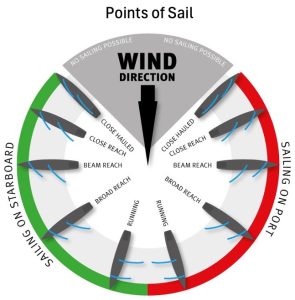
Sailboats cannot sail directly upwind. In fact, most sailboats can sail only about 45 degrees to the wind, many even less than that. With limited exception, all other angles are fair game. To make things simple in terms of communication between captains and helmsmen – the crew members steering the boat – seamen developed terms for the different “points of sail” that succinctly identify the direction of the boat relative to the wind. These terms are still very much in use today and are shown in the diagram below.
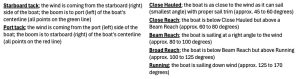
You may have noticed that the max angle listed when “running” is 170 degrees, not 180. This is for safety reasons. A boat CAN sail directly down wind but doing so, especially in a strong breeze, is dangerous. Wind is constantly changing direction. Often, these changes are small and are all but imperceptible to anyone on shore, but can have major ramifications when sailing “dead down”. A crash gybe occurs when the boom suddenly and unexpectedly swings from one side of the boat to other. Accidental gybes are one of the leading causes of significant injuries to skippers and crew and can also lead to significant damage to the boat, the sails and the rig – mast, boom, stays, etc. This is much more likely to happen when sailing that deep. Bottom line: avoid sailing dead down wind; if you have to do so, be extremely vigilant.